When a Dual-Key Home Gives a Multigenerational Family Real Privacy
A reported appeal for family-friendly design puts the focus on a practical choice: whether two living zones work better than one larger shared home.
Published 2026-10-08 · 6 min read
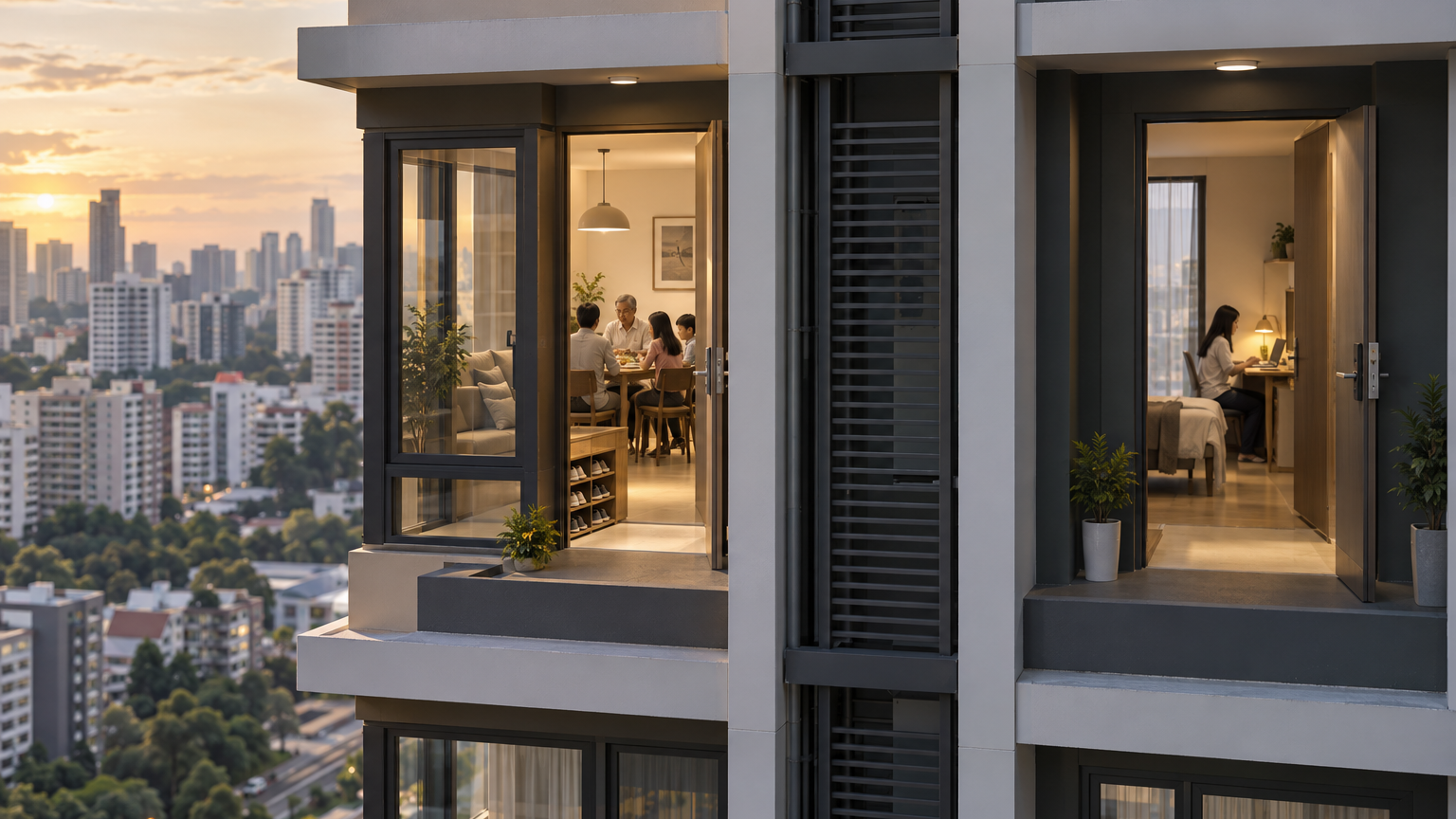
A household making room for an ageing parent, a newborn and two working adults may not need two properties. It does, however, need more than an extra bedroom opening onto the same busy living room.
That practical distinction has become timely after Indranee Rajah reportedly urged developers on 23 September 2026 to create more intentional spaces for children, older people and everyday caregiving. The examples extended beyond homes to family common areas and lactation facilities in commercial buildings. The appeal was reported from a Real Estate Developers’ Association of Singapore lunch; it was not an announcement of a new building rule, housing grant or special approval for dual-key homes.[S1]
Rajah, Minister in the Prime Minister’s Office and Second Minister for Finance and National Development, chairs the inter-agency Marriage and Parenthood Reset Workgroup established in April 2026.[S2] Its wider work includes caregiving and housing support, but buyers still have to judge individual homes on their actual layouts and costs.[S3]
A dual-key home is not simply a bigger flat
A genuine dual-key unit is one legal home arranged around two distinct living zones. A typical design has one shared main entrance or foyer, followed by separate internal doors: one to the larger family area and another to a compact suite.
That smaller zone may have its own bedroom, bathroom and pantry or kitchenette. The exact features vary, so the label on a listing matters less than what appears on the floor plan.
An ordinary three- or four-bedroom unit works differently. Everyone may have a private bedroom, but they usually share the same entrance, living room, kitchen and route to the bathrooms. This can suit a close-knit family perfectly well, yet it offers less control over noise, visitors and daily routines.
Consider a grandparent who wakes early, receives friends in the afternoon and wants to prepare a simple breakfast without entering the main kitchen. A separate suite may provide useful independence. If that suite has no proper food-preparation space, poor ventilation or a bathroom reached through a common area, much of the promised autonomy disappears.
The clearest comparison is therefore not “three bedrooms versus three bedrooms”. It is shared circulation versus independent circulation: who crosses whose space to enter, eat, bathe or welcome a visitor?
Put the floor plan through a normal weekday
A show flat can make two internal doors look wonderfully flexible. Before paying for that flexibility, walk through an ordinary Tuesday in your head.
Start with these six questions:
- Where does each person enter? Someone using the smaller suite should not have to pass through the main living room every time they come home.
- Can each zone reach a bathroom privately? This is especially important for an older resident moving around at night.
- What does “kitchenette” really mean? Check whether it has water, ventilation, storage and usable preparation space rather than just a counter.
- How easily does sound travel? Back-to-back televisions, doors beside bedrooms and a shared foyer can weaken the privacy suggested by the plan.
- Where will visitors wait? Two living zones are less independent if every guest must gather inside the family’s main area.
- Can caregiving still happen easily? Complete separation may be inconvenient if a frail parent needs frequent help or supervision.
There is also a space trade-off. An extra internal entrance, duplicated storage and a second pantry consume floor area. In a compact apartment, those features may leave the main living and dining area smaller than in a conventional unit of similar size.
This is why the best layout depends on the household. A healthy parent who values autonomy may appreciate a self-contained zone. A parent needing close assistance may be better served by an accessible bedroom near the main household, with fewer doors and shorter walking routes.
Two zones still produce one housing bill
The physical separation can make a dual-key home feel like two small apartments. Financially, buyers should assess it as one property and one purchase.
CPF housing usage depends on factors including the property type, remaining lease, loan arrangement and whether the buyer already owns property.[S4] The smaller suite does not create a second property that can be financed independently.
A realistic household budget should cover the full mortgage, maintenance charges, property-related costs and renovation. Duplicated fittings can also mean more items to maintain: another air-conditioning area, bathroom, refrigerator or pantry setup.
If rental income forms part of the plan, run the numbers with some vacancy rather than assuming twelve paid months each year. Also include costs that a headline rent can hide, such as agent fees, repairs, utilities included for the tenant and the household’s loss of access to part of its home.
Rental figures for ordinary one-bedroom units can offer a rough neighbourhood comparison, but they are not verified dual-key yields. A compact suite behind a shared front door may differ in privacy, facilities and tenant demand from a legally separate one-bedroom apartment. Its rent should not simply be copied from nearby listings and treated as assured income.
Separate doors do not create separate rental rights
A dual-key configuration does not automatically permit short stays, room-by-room co-living or the treatment of each zone as an independent dwelling.
For private homes, the general rental occupancy cap is six unrelated people. A temporary relaxation allows up to eight unrelated occupants in private residential properties measuring at least 90 sq m, subject to registration requirements, until 31 December 2028.[S5]
That is an occupancy limit, not blanket approval for every rental model. Owners still need to follow the applicable minimum-stay and occupancy rules, while a development may have by-laws affecting how common facilities or access arrangements are used.[S5]
This distinction matters when a sales pitch describes the smaller zone as an “investment unit”. Before relying on rent, establish what is legally permitted for the one dwelling, whether the proposed occupants satisfy current rules and whether the physical setup offers reasonable privacy.
The same caution applies within a family. A live-in parent or adult child may use the separate zone without turning it into another legal property. The layout changes how the household lives; it does not divide the title.
Buy the boundary your family actually needs
The reported push for more family-conscious spaces reflects a real design problem. Singapore households may need to accommodate young children, grandparents and caregivers while preserving sleep, privacy and some independence.[S1][S2]
A dual-key unit can answer that problem when its smaller zone matches a specific person and routine. It is less convincing when the household is paying for extra doors and duplicated fittings without needing genuine separation.
So begin with the family rather than the property label. Map who needs a private entrance, bathroom access, cooking space, quiet and caregiving support. Then compare the dual-key plan with a larger conventional unit—and make sure the household can comfortably afford either option as one home.
Sources
- Indranee urges developers to build more family-friendly spaces amid Singapore’s push to support parenthood · CNA
- How much CPF savings can I use for my property purchase · Central Provident Fund Board
- Marriage and parenthood measures at National Day Rally 2026 · National Population and Talent Division
- New workgroup to review policies and galvanise societal support for marriage and parenthood reset · National Population and Talent Division
- Temporary relaxation of occupancy cap for larger private residential properties extended · Urban Redevelopment Authority