Resale Homes Beat New Units on Median Returns—But Entry Price Is Only Half the Story
A reported 3.7% versus 2.7% historical gap rewards a closer look at what was measured—and how genuine dual-key layouts complicate the comparison.
Published 2026-10-08 · 6 min read
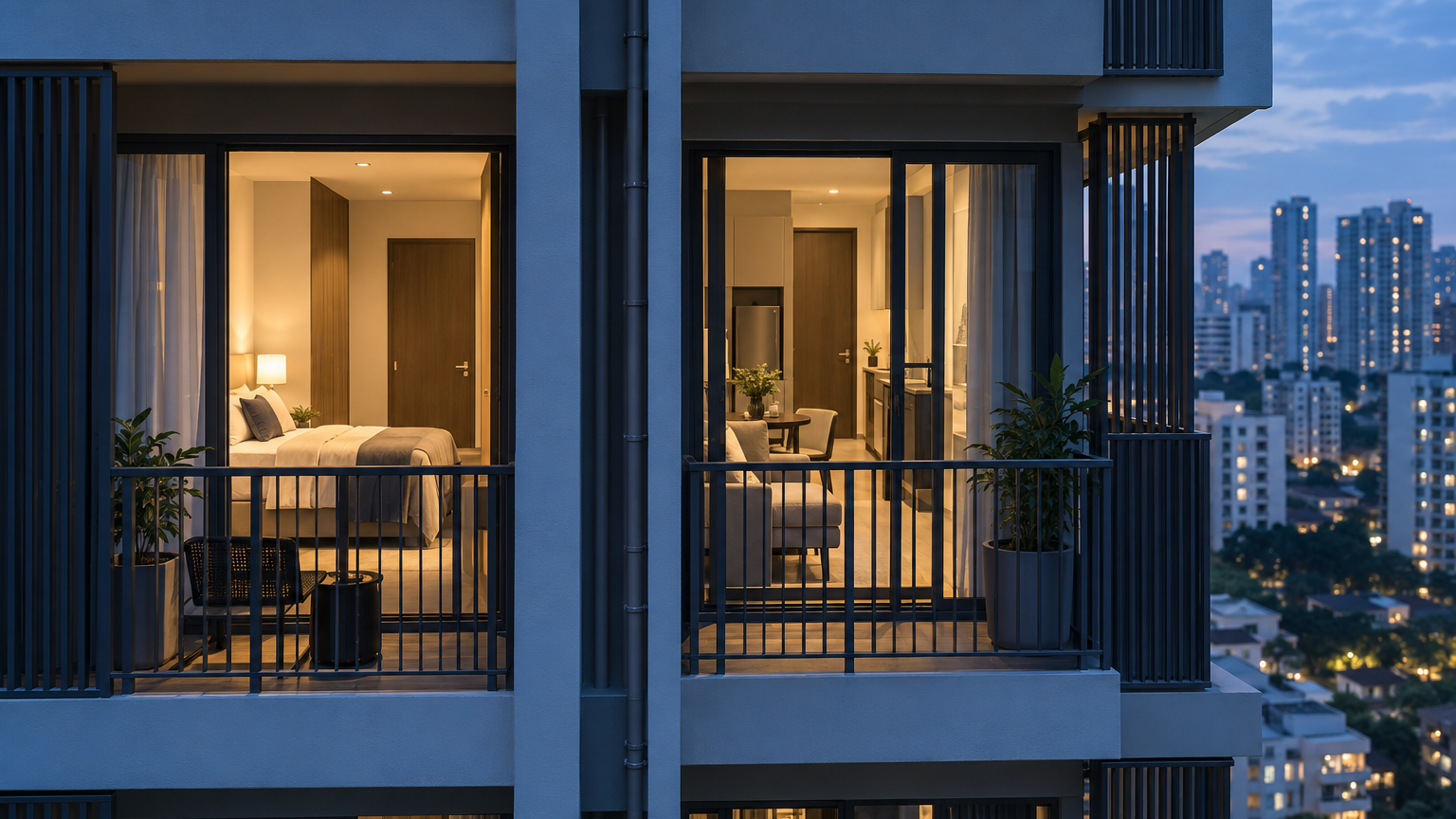
A 30-year-old medical professional identified only as Joshua paid S$2.1 million for a new freehold two-bedroom home near Holland Village in 2023. Nearly three years later, its value had barely moved, he said, just as his family was beginning to need more space.[S1]
His experience gives a human edge to a much larger finding. An analysis of more than 630,000 purchases and subsequent sales reported a median annualised return of 3.7% for resale private homes, compared with 2.7% for homes first bought from developers.[S1]
That one-percentage-point gap is interesting, but it needs careful unpacking—especially for households comparing a new launch with a resale dual-key home.
What the return figures actually measure
The analysis followed non-landed private homes bought between 1995 and June 2026 and later sold after a minimum holding period of three years. “Annualised” means the total price change was converted into an average yearly rate, making different holding periods easier to compare.
For example, a home bought for S$1 million and sold five years later for S$1.2 million gained 20% in total. Its annualised return would be about 3.7%, rather than 4%, because annualised calculations account for compounding. This is an illustration of the method, not an actual transaction from the study.
The comparison only covers realised exits—homes that changed hands again. It leaves out transaction costs, taxes, mortgage interest, rental income and inflation. The result is therefore a historical comparison of gross price growth, not the amount an owner ultimately kept.[S1]
This distinction matters. A buyer can record a decent increase in sale price but retain much less after paying for financing, renovation and the eventual sale. Another household may accept slower price growth because a home works unusually well for parents, adult children or other living arrangements.
Why resale homes may have had a lower hurdle
The figures compare two entry routes. One group bought directly from a developer; the other bought an existing home from a previous owner.
A new home may offer fresh fittings, modern facilities and less immediate renovation. But those attractions can be reflected in its initial price. If the buyer pays a substantial new-launch premium, the home must first grow beyond that higher starting point before producing the same percentage return as a cheaper comparable resale unit.
Imagine two broadly similar homes. One costs S$2 million new, while the resale alternative costs S$1.8 million. To gain 20%, the new unit must eventually sell for S$2.4 million; the resale unit needs S$2.16 million. The resale home starts with a S$240,000 lower target for that same percentage gain.
That calculation explains the hurdle, not the outcome. Differences in age, floor, view, tenure, location, condition and layout can easily make two apparently similar homes poor comparables.
Transaction records also need context. URA classifies developer sales using Options to Purchase issued by developers, while resale and subsale records are based on caveats lodged with the Singapore Land Authority.[S2] URA notes that lodging a caveat is not compulsory, so its search records should not be treated as a complete census of every private-home transaction.[S2]
A dual-key unit is more than a home with extra bedrooms
The reported return gap was not a study of dual-key homes. Buyers should not simply attach the 3.7% resale median to a resale unit carrying that label.
For a practical comparison, we use “genuine dual-key” to mean one home deliberately arranged as two connected living zones: a main residence and an ancillary area with its own access from a shared entrance or foyer. The crucial feature is meaningful separation, not merely three or four bedrooms behind one conventional front door.
That difference affects everyday use. A properly separated ancillary area may give an older parent more privacy, allow an adult child greater independence or help a household separate work and living space. An ordinary spare bedroom beside the family living room cannot offer the same experience, even if an advertisement loosely describes it as flexible living.
It also changes how comparable sales should be selected. The best evidence for a resale dual-key unit is another genuinely dual-key unit in the same project or a closely comparable development. If none has sold recently, separate the value of the underlying home—location, size, tenure, floor and condition—from the possible value of its divided layout.
Do not rely on bedroom count alone. Two homes advertised as three-bedroom units may differ sharply if one uses part of its floor area for a second entrance, kitchenette or internal foyer. Look at usable room dimensions and circulation space, not just the marketing label.
Price indices answer a different question
A broad property index cannot settle whether buying new or resale produced the better household outcome. Singapore’s private residential price index uses a hedonic method, which adjusts for property characteristics such as age and unit size when measuring market price changes.[S3]
That is useful for tracking the wider market. It does not follow an individual buyer from purchase to eventual sale or subtract that household’s mortgage and other expenses.[S3]
The distinction is easy to miss. A rising index can coexist with a disappointing result for someone who paid a high entry price, while a flat quarter for the wider market does not mean every owner’s home stood still.
URA’s transaction search can help a buyer inspect recorded deals by project and sale type.[S2] For dual-key homes, however, transaction data may not identify every internal layout clearly. Floor plans, listings and project records may still be needed to establish whether a supposed comparable really has separate living zones.
Compare the home’s job as well as its return
A household choosing between a new conventional unit and a resale dual-key home is making two decisions at once.
The first is financial: total purchase price, required cash and borrowing, remaining lease where relevant, likely renovation, ongoing upkeep and eventual selling costs. The reported return analysis does not combine those items into an all-in household result.
The second is practical: whether the separation will genuinely be used. Privacy for a parent has value even if it never appears in a transaction database. But an awkward ancillary area that sits empty can become expensive floor space rather than a useful household feature.
Resale offers one advantage during this comparison: buyers can usually inspect the completed space and judge its light, noise, access and privacy directly. With an uncompleted new unit, more of that judgement depends on plans and specifications.
The historical numbers make one point especially well: entry price matters. They do not make resale universally superior, and they do not establish an automatic dual-key premium. The useful next step is to compare genuine dual-key layouts with one another, then ask whether the price difference buys privacy your household will actually use—and whether past buyers found someone willing to pay for it again.
Sources
- Many happy returns for resale homes · The Business Times
- Private Residential Property Transactions · Urban Redevelopment Authority
- Private residential property transactions datasets · data.gov.sg