Private Home Prices Rose 1.4%—But Dual-Key Buyers Need a Closer Test
Suburban condos helped lift the private index as HDB resale prices dipped, yet layout, privacy and comparable sales matter more than the headline for dual-key households.
Published 2026-10-08 · 6 min read
Singapore’s private-home prices rose 1.4% in the third quarter of 2026, while HDB resale prices slipped 0.2%, according to the latest flash estimates. The split is striking, but the detail matters: landed homes and private housing outside the central region recorded the strongest increases.[S1][S2][S3]
For a household considering a dual-key condo, that is useful market context—not an answer. The real question is whether the unit provides two genuinely workable living zones for parents, an adult child or a tenant, and whether that flexibility is worth any premium over a conventional apartment.
Private prices rose, but not evenly
The Urban Redevelopment Authority’s preliminary index showed private residential prices rising 1.4% quarter on quarter, faster than the 0.5% increase in Q2. Landed-home prices climbed 2.8%, while non-landed prices—which cover apartments and condominiums—rose 0.9%.[S1]
Location made a considerable difference within the non-landed segment. Prices increased 2.2% in the Outside Central Region, which broadly covers suburban private housing, and 0.2% in the Rest of Central Region. They fell 0.1% in the Core Central Region.[S1]
That suburban increase may catch the eye of dual-key shoppers because many family-oriented condominiums sit outside central Singapore. But URA’s index covers a broad range of homes and does not publish a separate result for dual-key units. A particular unit’s value still depends on matters such as its development, tenure, floor, size, condition and layout.
The preliminary private-home transaction count also moved differently from prices. URA recorded 4,296 sale transactions up to mid-September, around 30% fewer than the 6,148 transactions recorded throughout Q2. The flash index was compiled using stamp-duty records and developer sales information available by the middle of September.[S1]
Public housing went in the other direction. HDB’s flash estimate showed resale prices declining 0.2%, the third consecutive quarterly fall, even as 7,528 resale flats changed hands by 29 September—17.7% more than in Q2.[S2][S3]
These are preliminary figures rather than final quarterly statistics. URA is due to publish its complete Q3 private-property data on 23 October 2026, when more transactions and the quarter’s full market activity will be captured.[S1]
A dual-key unit is not simply an apartment with more bedrooms
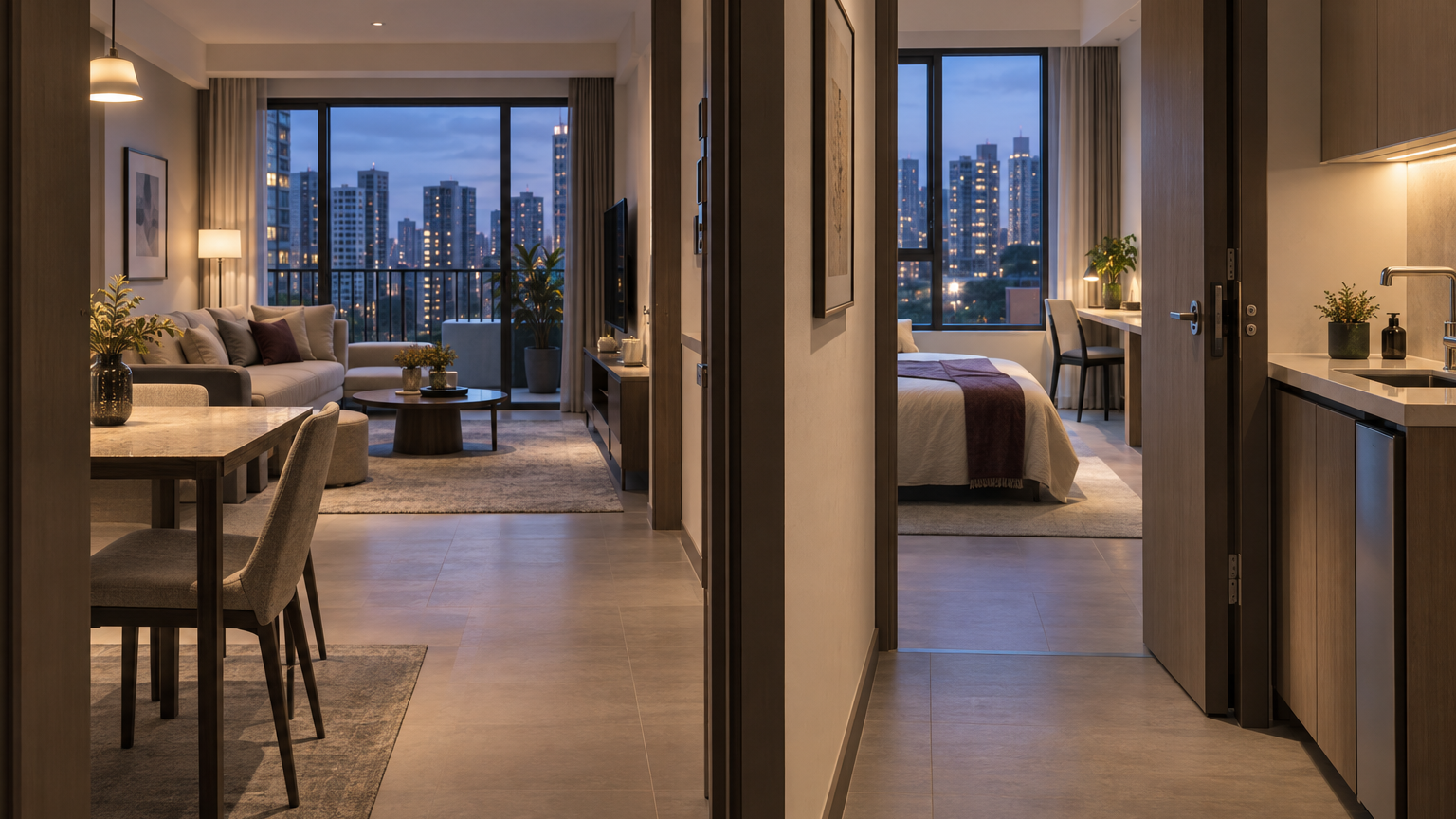
The phrase “dual-key” is used loosely in listings, so buyers should look beyond the label. In practical terms, a genuine dual-key layout remains one strata home but contains a main living area and a more independent auxiliary zone, typically reached without walking through the main household’s private rooms.
That is different from an ordinary multi-bedroom apartment where everyone shares the same entrance, kitchen and living room. It is also different from an apartment informally altered with an extra partition or door.
URA advises buyers to check a property’s approved plans and whether additions or alterations have received the necessary approvals. Its renovation guidance also states that partitioning which creates new sub-units within an original dwelling is not exempt from planning permission.[S4][S6]
Ask for the approved floor plan and compare it with the physical unit. A marketing floor plan can help explain the space, but it should not be the only evidence that the advertised arrangement is authorised.
A useful inspection starts at the front door. Can someone enter the auxiliary zone without passing through the main living room? Does that zone have the facilities shown on the approved plan? Where do both households meet to do laundry, dispose of rubbish or reach shared utilities?
Privacy is measured in daily routines
A separate entrance can look persuasive during a ten-minute viewing. Daily life is a tougher test.
Imagine one side being used by ageing parents. Is the route from the lift to their room step-free? Can they reach a bathroom safely at night? If the smaller zone lacks practical food-preparation space, will they still need to enter the main home several times a day?
For an adult child, the issue may be acoustic and social privacy. Check whether beds sit against a shared wall, whether conversations travel through connecting doors, and whether one household must cross the other’s space to reach the washer or storeroom.
The floor area also needs context. A dual-key configuration can devote space to a second entrance, internal doors or duplicated facilities. Compare its usable rooms with those of an ordinary unit of similar total size, rather than assuming every square foot creates the same household value.
This is where a genuine family benefit can be worth more than a spreadsheet suggests. Parents may retain independence while remaining close to their children; an adult child may have privacy without maintaining a separate home. But those benefits depend on how the particular floor plan works, not on the dual-key name alone.
Price the flexibility separately from hoped-for rent
To assess a premium, begin with completed sales of ordinary and dual-key units that are as similar as possible. The best comparisons are usually within the same development; otherwise, match tenure, location, floor area, floor level, age and condition closely.
Suppose a dual-key unit costs $120,000 more than a comparable conventional apartment. That difference is not automatically the “price of an extra rentable studio”. Part may reflect a larger floor area, higher floor, renovation or better facing. Strip out those differences before deciding how much is genuinely attributable to the layout.
Next, work out the recurring cost of the choice. Include the mortgage payment and interest, maintenance fees, property tax, insurance, repairs and an allowance for vacancy. Financing is secured against the whole home: the presence of two living zones does not turn one purchase into two separately financed properties.
Potential rent should be treated cautiously. Asking rents for one-bedroom apartments can provide neighbourhood context, but they are not verified evidence of what an auxiliary zone inside a specific dual-key home will achieve. The space, access, facilities, privacy and permitted occupancy arrangement may be quite different.
Private residential properties generally cannot be rented for stays shorter than three consecutive months. Daily and weekly accommodation is not allowed.[S5] A dual-key layout also does not by itself establish permission to operate co-living accommodation or any particular room-by-room arrangement; buyers should verify the proposed use against current rules and any applicable development restrictions.
Stress-test the sums without rent as well. If the household cannot comfortably service the loan during a vacancy, renovation period or change in family plans, the arrangement is relying on income that has not yet been secured.
The better question after a 1.4% rise
The private-price increase tells buyers that Q3 was firmer overall, particularly for landed homes and non-landed properties outside central Singapore.[S1] It does not replace evidence about the unit being considered.
For a dual-key buyer, three comparisons matter most: the approved plan against the actual home, the asking price against closely matched completed sales, and the monthly ownership cost against conservative lawful rent assumptions. Then comes the most personal comparison of all—whether the two zones provide enough independence for the people who will actually live there.
URA’s final Q3 figures will sharpen the market picture on 23 October.[S1] They still will not reveal whether a particular second doorway creates meaningful privacy or merely adds cost. That answer is waiting in the floor plan, the comparable transactions and an honest rehearsal of everyday life.
Sources
- Flash Estimate of 3rd Quarter 2026 Resale Price Index and Upcoming Flat Supply · Housing & Development Board
- Private home prices accelerate with 1.4% rise while HDB resale values dip further in Q3: flash data · The Business Times
- Buying Property · Urban Redevelopment Authority
- Release of flash estimate for 3rd Quarter 2026 private residential property price index · Urban Redevelopment Authority
- Renovating Private Residential Property: Strata-Titled Residential Property · Urban Redevelopment Authority
- Renting Property · Urban Redevelopment Authority