One Award From Three Long-Stay Apartment Tenders
The mixed SA2 results explain developer caution—but dual-key buyers still need to judge privacy, permitted use and whole-home costs.
Published 2026-10-08 · 6 min read
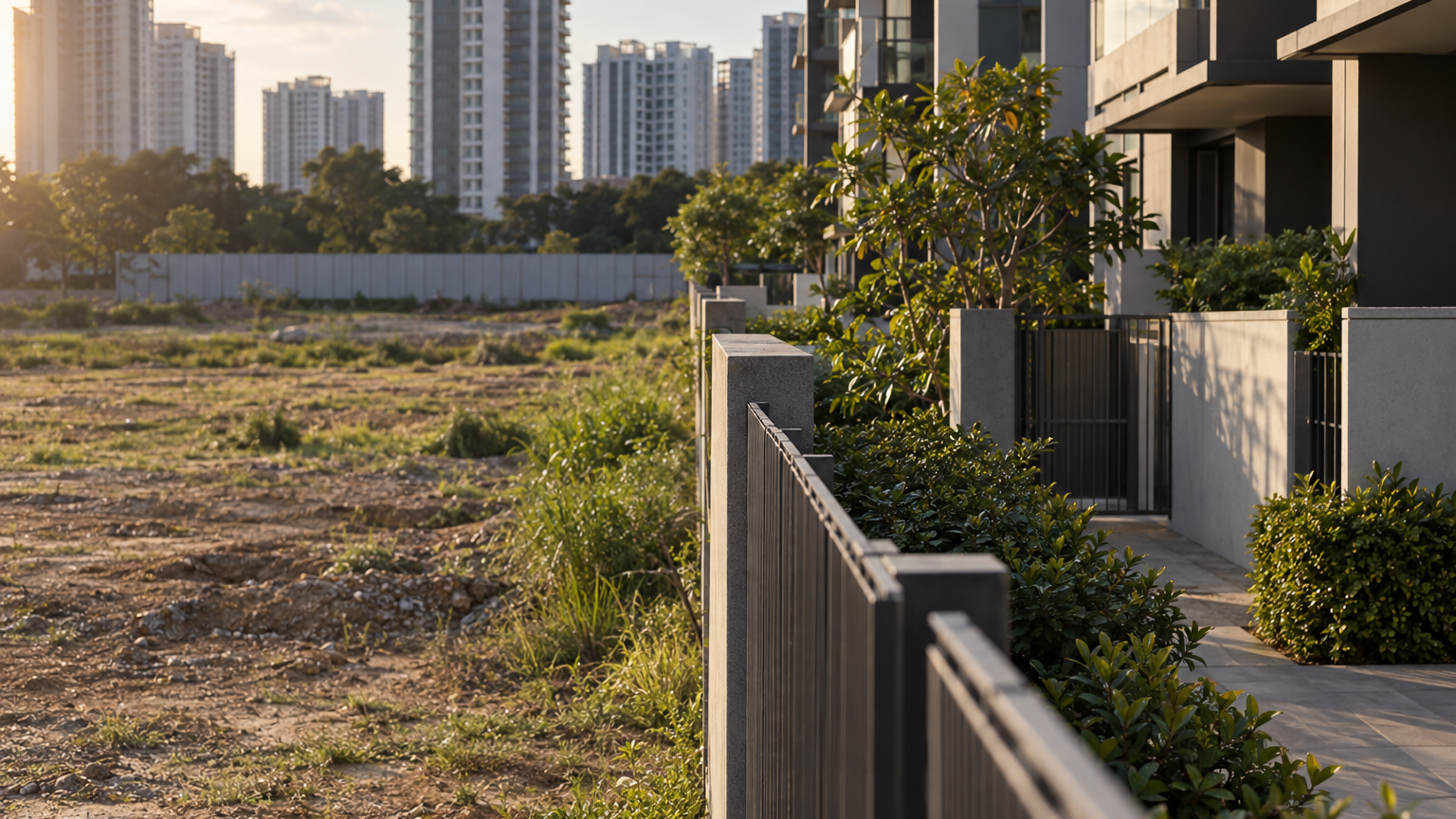
Singapore’s first three government land tenders involving long-stay serviced apartments ended very differently: Zion Road was awarded, Upper Thomson received no bids, and Media Circle’s only bid was rejected as too low.[S1][S2][S3]
For a household considering a dual-key condo, the sequence is worth understanding—but it is not a ready-made rental forecast. These tenders tested buildings run by single operators, not privately owned homes divided into two practical living zones.
What URA was testing
URA introduced Serviced Apartments II, or SA2, in December 2023. Unlike conventional serviced apartments, SA2 units require a minimum stay of three months. They cannot be strata subdivided for sale and are expected to remain under one ownership and operator.[S4]
Zion Road (Parcel A) and Upper Thomson Road (Parcel A) were the first government land-sale sites launched with compulsory SA2 components. URA estimated that the pair could produce about 535 SA2 units and 1,275 conventional homes in total.[S5]
The model therefore sits somewhere between an ordinary rental apartment and a serviced residence, but its ownership structure is quite different from a condo. The operator must develop and manage the rental accommodation as a continuing business instead of selling each apartment to an individual owner.
One award from three early tenders
The tender chronology is more informative than a simple comparison between neighbourhoods:
- Zion Road (Parcel A): URA awarded the site in April 2024 for S$1.106888 billion to CDL-MFA Vega Property and CDL-MFA Altair Property. At least 20,000 sq m of gross floor area—the approved floor space—must be used for SA2 accommodation.[S1]
- Upper Thomson Road (Parcel A): the original tender closed in June 2024 without receiving a bid.[S2]
- Media Circle: this 60-year leasehold site was intended entirely for SA2 use. It received one bid, but URA declined to award the tender in October 2024 because it considered the price too low.[S3]
That makes one award from the first three SA2-related tenders. This is a count of land-tender outcomes, not an occupancy rate or measure of rental profitability. No completed SA2 operation was being assessed by those tenders.
URA later said that, after considering market feedback, it would retain SA2 use at Media Circle but remove the compulsory SA2 requirement from Upper Thomson Road (Parcel A).[S6] The Upper Thomson parcel returned to the market in June 2025 without that mandatory component.[S7]
The revised site was eventually awarded on 31 October 2025 to a joint venture involving Wee Hur Property and GSC Holdings, according to Wee Hur’s SGX filing.[S8] That later award concerned the reworked tender, so it was not a revival of the original compulsory SA2 proposal.
Why this was not just about location
It is tempting to read the results as a clean contest in which central Zion Road won and Upper Thomson lost. The sites, however, came with different lease lengths, scales and development requirements. Media Circle was a 60-year site devoted to SA2, while Zion Road combined conventional housing with a specified amount of SA2 floor space.[S1][S3]
A developer also has to price more than expected rent. Its bid must account for the land, construction, financing, management and the risk of holding rental accommodation that cannot be sold unit by unit.
The useful interpretation is that developers had different appetites for three different packages of land and operating conditions. Location was part of each package, but the tender results do not separate its effect from every other cost and restriction.
Zion Road’s award establishes that one bidder accepted its conditions and price. The more meaningful rental evidence will arrive only after SA2 homes are completed and their rents, occupancy and running costs can be observed.
An SA2 building is not a dual-key home
For this comparison, a genuine dual-key home means one residence designed with two independently usable internal living zones, usually arranged behind a shared main entrance. The practical attraction may be privacy for a parent or adult child, or separation between an owner’s space and a conventional long-term tenant’s area.
An ordinary three- or four-bedroom condo does not become dual-key simply because one bedroom sits near the entrance. Buyers should inspect the approved floor plan and actual unit rather than relying on a listing label.
Look at how each zone functions. Does it have sensible access to a bathroom? Can occupants enter without walking through the other side’s private space? Are the doors and walls likely to provide enough visual and sound separation for different schedules? Any kitchen or food-preparation facilities should also match the approved layout.
SA2 follows a different model. Its apartments remain together under one operator instead of being sold as individual strata units.[S4] A dual-key owner, by contrast, must make the whole-home purchase work for that household’s needs and finances.
This is also why future SA2 room rates—or rents for nearby one-bedroom apartments—cannot simply be presented as a dual-key yield. They may offer comparison points, but they do not capture the exact floor area, privacy, shared access and furnishing of a particular dual-key zone.
Start with privacy and the whole-home cost
A dual-key layout may be most valuable when it can change with the family. The smaller zone might house a parent today, an adult child later and a long-term tenant at another stage. That flexibility matters only if the space remains comfortable and useful in each scenario.
Run the financing calculation for the whole home, including periods when the smaller zone earns no rent. Against any realistic long-term rent, allow for mortgage interest, maintenance fees, property tax, agent fees, furnishing, repairs and vacancies. There is a personal cost too: the main household gives up some floor area and privacy.
Compare that result with buying a conventional home that suits the family better. Another useful comparison is an ordinary larger unit with a rented bedroom: it may offer less separation, but it could cost less or provide a more efficient main living area.
Occupancy plans must remain within residential rules. URA states that private residential properties cannot be used for stays shorter than three consecutive months. A dual-key layout does not authorise nightly accommodation, holiday lets or hotel-style turnover.[S9]
The three SA2 tenders offer a useful lesson, but not a rent promise. Institutional serviced apartments, dual-key homes and ordinary multi-bedroom condos can all house tenants; their ownership, costs and privacy arrangements are fundamentally different. For a dual-key buyer, the approved layout and full monthly holding cost remain more useful than any land bid.
Sources
- Upper Thomson Road (Parcel A) GLS tender launch in June 2025 · ERA Singapore
- Wee Hur filing identifying the Upper Thomson Road award · Singapore Exchange
- Government Land Sales Programme update, December 2024 · Urban Redevelopment Authority
- Launch of Zion Road and Upper Thomson Road pilot sites · Urban Redevelopment Authority
- New Serviced Apartments II pilot guidelines · Urban Redevelopment Authority
- Short-term accommodation rules for private residential properties · Urban Redevelopment Authority
- Tender closing for Upper Thomson Road (Parcel A) · Urban Redevelopment Authority
- Tender decision for Media Circle long-stay serviced apartment site · Urban Redevelopment Authority
- URA awards tender for Zion Road (Parcel A) · Urban Redevelopment Authority